
So, what’s going on in your dog’s head when you see things like an ear flick or a slow blink? What about if you see a tail that’s a little too low? Many people notice some of their dog’s non-verbal messages, especially the trained pet sitters from places like Traverse City, but very few notice all of the messages and signals that they use to communicate.
If you can discern the different signals, you will have transformed the relationships you can have and the care you will receive. Most importantly, you will be an appropriate advocate for your pet. This skill will help you in most situations that require using dog wheel in home pet-sitting services. You will be able to distinguish the signs that help you know that your dog is safe and comfortable in new surroundings.
Dogs use body language to communicate almost exclusively, and the American Kennel Club studies show it is the main language they use. It can be interesting to examine and interpret dog body language. It is a part of responsible pet ownership.
Why Body Language is Important
The relationship between dogs and people has been going on for over 1000 years, and during that time, the communication that has developed is unique. Dogs have over 30 different facial expressions that represent a variety of emotions, and that is just to communicate with people.
Your dog is unable to communicate verbally to their sitter while you are away for work or on vacation. While some dogs overwhelm their carer and display negative behaviours, other dogs are more subtle. Increasing behavioural awareness amongst caretakers is why it is essential to choose someone with the right experience to dog-sit in Traverse City.
Signs Your Dog is Calm and Happy
The sign of relaxation Dogs’ display goes far beyond a tail wag to sign contentment. A dog should show multiple, consistent and behavioural signals of relaxation to show their contentment is true and genuine.
A Relaxed Dog Face
An overall general picture of relaxation in a dog is their relaxed face. The eyes of a relaxed dog will be fully encased, show sclera only in the corners, and will be relaxed enough to even show a bit of an open mouth. The mouth of the relaxed dog will be fully opened so as to display their tongue. The dog’s ears will be relaxed, not pinned, not fully alert, and positioned naturally.
Body Posture Indicators
Calm dogs have even weight distribution over their fore and hindquarters. The muscle tone remains loose and relaxed. More indicators include:
- The tail is positioned midline and is moving in an unhurried, side-to-side arc.
- The shoulders are relaxed and the spine is in a neutral position.
- The dog is lying on their side or is in a belly-up position.
- Breathing is even as though in a deep sleep.
Behavioral Cues
Relaxed dogs display a high level of confidence in the environment around them. They will initiate new interactions with an unfamiliar person and get up or change position to engage in new activities.
| Have questions or need more details? We’re here to help! Reach out today to learn how our pet sitting services keep your dog calm, happy, and well-cared for. |
Warning Signs of Stress and Anxiety
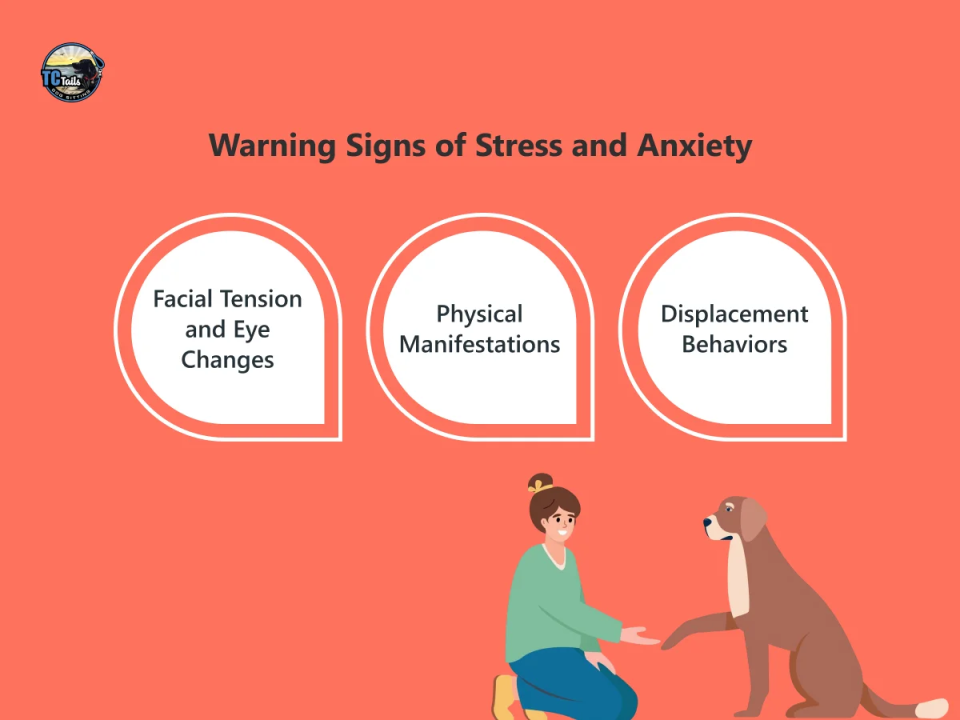
Stress is expressed in different ways by different dogs. Stress indicators shown by a dog that lacks the training to cope with stress should be dealt with immediately to avoid the dog overreacting out of fear or aggression. Professional pet-sitting services in your area have been trained to recognise these warning indicators early to allow them to intervene appropriately.
Facial Tension and Eye Changes
“Whale eye” is a commonly shown sign of stress. The whites of the eye are more visible than the iris and are in the shape of a crescent. The pupils may appear larger. Avoiding eye contact or even staring without blinking is a sign of discomfort. Other signs of discomfort include lip licking, yawning, and smiling by pulling the lips back.
Physical Manifestations
Anxiety reveals itself in a number of ways and the body will show the signs:
- The tail is tucked in or is held still and straight close to the body
- Dogs are weighted back with their body as if they want to leave
- Raised fur is seen all along the back and shoulders
- The dog is panting a lot for no reason (not hot or tired)
Displacement Behaviors
Your dog can be under stress and show signs of it in the form of what may seem like random actions to you, but these actions may be your dog’s way of coping with the stress. Trying to self-soothe will show signs of stress in the form of sudden or overly repetitive actions like dry shaking, obsessive ground sniffing, or sudden random scratching.
How Professional Caregivers Use This Knowledge
With years of work across all temperaments of dogs in their home pet sitting, these professionals must develop remarkable observational skill that is well beyond the average dog owner. They skilfully and continuously monitor body language to provide, and fine-tune, activities, settings, and interplays to what their dog is saying.
With anxious dogs and dogs that have special needs or behaviours, professionals can help give dogs the pet stay of their dreams and remove the exposure of the dog to stressful situations. Quality professionals provide peace of mind to pet parents by documenting the stay with a large number of photos and videos, capturing the dogs in their true emotional state.
When determining the best pet service provider, parents in Traverse City need to consider how the provider interprets and deals with anxiety in dogs. Providers with more experience will recognise and interpret the various signs of stress and have protocols in place to deal with anxious dogs.
| Make sure your dog gets the love and attention they need when you’re not home. Reserve your stay with TC Tails’ reliable sitters today! |
Interpreting Canine Body Language
Observing how your dog interacts with your candidate service provider during their first meeting is very important. Look closely at your dog’s body language during the meeting, as they will provide signals as to how they feel about the meeting and the service provider.
If your dog is happy and relaxed, they will gladly approach the new person with an open and relaxed body. They will be curious enough to sniff and will be able to take treats and will seek out more than one round of gentle petting. They will engage with the new person and be social. If your dog scans the body of the new pet provider and shows anxious and avoidant behaviour or is unable to engage with the person in any manner, the arrangement will not fit with your dog’s social comfort level.
Your dog will communicate their feelings very clearly and it is important to interpret that communication without putting the feelings of the service provider over the needs of your dog.
Final Thoughts
Understanding how to interpret your dog’s body language is imperative in having peace of mind while your pet is at home or on the road. The signs that your dog is happy and relaxed include ‘soft eyes, a relaxed body, and calm settling into the area.
This understanding becomes your best friend while on the journey to choosing a pet-sitting service for your animal companion. Sitters who understand dog communication, notice the signs of stress before it worsens, and send updates containing photos of the dogs they’re watching, and the dogs appear to be at ease, genuinely relaxed, and stress-free, deserve your attention and consideration. The only thing that really tells the true story of your dog’s experience during the stay is the photos and all the work dogs’ fluid, canine bodies do while they stay at the pet-sitting place.
TC Tails is an excellent choice, as they provide at-home dog boarding in Traverse City and have over two decades of experience in and around the Traverse City area caring for and providing personalized service. Don’t hesitate to reach out to Jared and book some meet-and-greet time for you to see how your dog interacts with this gentle home care. This is because your dog speaks, and their voice is comfort.
FAQs
How long will it take me to read my dog’s body language properly?
Structure observation for two weeks and watch the significant changes that will take place. Pay attention to your dog in new environments to see how they stress and how it will change their body language.
Don’t all dogs show stress the same way?
No. Specific breed traits impact their body language as well as their body’s facial features and extremities. For flat-faced dogs, it’s common for them to have a lesser change in their body language, and for dogs with cropped ears, they may provide a simpler version of the signals. Most importantly, remember to learn and understand your own dog.
My dog is stressed. What do I do?
If you are stressed about the dog’s potential stress, do not hesitate to communicate with the pet attendant. If stress is not alleviated after an adjustment period, maybe the location isn’t the best fit for your dog’s personality.
Is it common for dogs to fake being stressed?
While dogs do not have the capacity for purposeful deception, some dogs are able to mask stress temporarily. Instead of focusing on isolated stress signals, it is best to look for clusters, as this will provide a clearer picture of the dog’s emotional state.
How do pet carers identify stress with dogs they are meeting for the first time?
Experienced pet carers identify baseline behaviours seen during an introduction meeting, note any behaviour changes during the pet stay, and comprehend common stress signals that every dog may exhibit, showing the universal nature of stress regardless of individual dogs.
