
Unsocialized dogs placed in group daycare typically experience stress, fear, and over-arousal rather than positive socialization. Without prior exposure to other dogs in controlled settings, they may freeze, hide, bark excessively, snap, or shut down entirely. Group daycare is not a fix for poor socialization – it often makes anxiety and reactivity worse.
Key Takeaways:
- Group daycare is not a socialization tool – it’s an environment for already-socialized dogs to enjoy
- Unsocialized dogs in group settings typically experience fear and stress, not positive learning
- Signs of distress in daycare include hiding, excessive panting, snapping, and inability to settle
- In-home dog boarding with a single resident dog is a far gentler entry point for undersocialized dogs
- A meet and greet before any boarding stay is essential for assessing a dog’s actual readiness
- Dogs in Traverse City with socialization gaps have safer options than large-group daycare facilities
Table of Contents (8 min read)
- Why Daycare Is Not a Socialization Fix
- What Unsocialized Dogs Experience in Group Settings
- The Stress Response: What It Looks Like in Real Time
- How Daycare Can Make Socialization Problems Worse
- Dogs Who Should Not Start With Group Daycare
- What to Do Instead: Safer Options in Traverse City
- How TC Tails Handles Dogs With Socialization Gaps
- Frequently Asked Questions
Why Daycare Is Not a Socialization Fix
Here’s a mistake well-meaning dog owners make all the time. Their dog is nervous around other dogs, hasn’t been around many since puppyhood, or just seems awkward in social situations. So they think: daycare will fix this. Exposure is good, right?
It’s not that simple. And for a lot of dogs, that decision backfires badly.
Socialization isn’t the same thing as exposure. True socialization involves gradual, positive introductions at a pace the dog can handle – with enough space to retreat, with a handler who can read the dog’s body language, and with experiences that build confidence rather than overwhelm. Group daycare at a busy facility with 15 to 25 dogs is the opposite of that. It’s the deep end of the pool, and an unsocialized dog doesn’t know how to swim yet.
The American Veterinary Society of Animal Behavior has been clear on this: the goal of socialization is to help dogs form positive associations with the world around them. Flooding them with stimulation they aren’t equipped to handle doesn’t create positive associations. It creates fear memories.
And fear memories are much harder to undo than they are to prevent.
So before you book dog daycare in Traverse City – or anywhere – it’s worth understanding what an unsocialized dog actually goes through when you drop them into a group setting.
What Unsocialized Dogs Experience in Group Settings
Picture your dog walking into a room full of unfamiliar dogs, unfamiliar smells, unfamiliar sounds. Barking from every direction. Dogs rushing over to sniff. No familiar person within reach. No exit.
For a well-socialized dog, this is Tuesday. For an unsocialized dog, this is a crisis.
Their nervous system immediately goes into threat-assessment mode. The brain’s amygdala – the part responsible for fear responses – fires fast. And what happens next depends on the individual dog.
Some freeze. They stand rigid, unable to move, trying to disappear. Other dogs read this stillness as an invitation and swarm them, which makes it worse.
Some try to escape. They press against walls, look for corners, try to find any space that feels safer. In a large group setting, there often isn’t one.
Some go into a reactive state. Barking, lunging, snapping – not because they’re “aggressive” in the clinical sense, but because they’re terrified and have no other tool available. They’ve never learned that other dogs are safe, so their brain tells them to create distance by any means necessary.
And some shut down entirely. They stop responding, stop moving, stop eating treats, stop engaging. Trainers call this “learned helplessness” – a state where the dog has essentially given up trying to cope.
None of these are the dog being difficult. All of them are the dog communicating, clearly, that they are not okay.
If you’re in Traverse City and you’re not sure whether your dog is ready for a group setting, text 231-499-4048. A free conversation before booking can save your dog a genuinely bad experience.
Read More About: What Happens During a Dog’s First Day at Doggy Daycare
The Stress Response: What It Looks Like in Real Time
Stress in dogs isn’t always obvious. Most people expect a dog to growl or snap when they’re uncomfortable. But the signs usually show up much earlier – and most daycare facilities don’t catch them until the dog is already past the point of recovery.
Early stress signals (often missed)
- Lip licking not related to food
- Yawning repeatedly in an active environment
- Turning the head or body away from other dogs
- Blinking rapidly or looking away from direct eye contact
- Tail tucked even while still moving around
- Refusing food or treats they’d normally take anywhere
- Excessive panting when the environment isn’t hot
- Sniffing the ground compulsively as a way to avoid engagement
Escalating stress signals
- Stiff, slow movements with a low or rigid tail
- Whale eye (the whites of the eyes showing)
- Moving in wide arcs to avoid other dogs
- Pressing against walls, fences, or corners
- Pacing without settling
- Hard, direct staring at another dog
Crisis signals
- Growling with no prior warning signs caught
- Snapping in the air (an air snap is a final warning, not an attack)
- Lunging or barking at other dogs relentlessly
- Complete shutdown – unresponsive, flat, unable to engage
The problem in most group daycare settings is that by the time a dog reaches the crisis stage, the earlier signals were missed or ignored. Staff-to-dog ratios simply don’t allow for the kind of close behavioral monitoring that would catch lip licking at dog number seven of twenty.
An experienced in-home dog sitter, working with two or three dogs at most, can catch those early signals and intervene before the dog ever reaches distress.
How Daycare Can Make Socialization Problems Worse
This is the part that most daycare providers don’t tell you, because it’s bad for business.
Putting an unsocialized dog into group daycare doesn’t just fail to help – it can actively set the dog back.
Here’s why. Every time a dog has a frightening experience with another dog, their brain logs it. The amygdala stores fear memories with a kind of priority encoding – they’re sticky, they’re fast to retrieve, and they’re hard to overwrite. One bad group experience can create a negative association with other dogs that takes months of careful counter-conditioning to undo.
If your dog goes to daycare scared, and comes home scared, and goes back scared the next time – you’re not desensitizing them. You’re rehearsing fear. You’re making the fear response faster and more automatic.
Dog trainers see this constantly. A dog that was just “a little nervous” around other dogs gets sent to group daycare because the owner thought exposure would help. Three weeks later, that dog is reactive on leash, lunging at dogs across the street, and genuinely worse than they were before. Not because daycare made them aggressive. Because repeated, unmanaged fear experiences hardwired a response pattern that didn’t exist before.
This is why socialization has to happen gradually, positively, and at the dog’s pace. Not by flooding.
What appropriate early socialization looks like instead
- Controlled one-on-one introduction with a calm, stable dog
- Short sessions with ample opportunity to disengage
- Handler present and monitoring the entire time
- Positive reinforcement for calm, curious behavior
- No pressure to “keep up” with other dogs
- Gradual increase in group size only as the dog shows readiness
That’s not what group daycare looks like. But it is what a good in-home boarding situation can look like – especially with a resident dog like Charlie, who is stable, submissive, and has a track record of helping nervous dogs relax.
Dogs Who Should Not Start With Group Daycare
Not every dog is wrong for daycare forever. Some dogs just aren’t ready yet, and need a different starting point. Others may never thrive in a large group environment, and that’s completely fine.
Here are the dogs that should not be placed directly into group daycare settings:
Dogs with no prior dog-to-dog interaction since puppyhood. If your dog grew up without contact with other dogs and is now two, four, or eight years old, a group of twenty dogs is not a good first introduction. They need one dog, in a calm space, for a short period – not a crowd.
Dogs showing any signs of reactivity on leash. Leash reactivity – barking, lunging, or straining toward other dogs on walks – is almost always a sign of anxiety or over-arousal in social situations. Group daycare will not fix leash reactivity. A structured behavior program will.
Dogs who have had previous negative experiences with other dogs. A dog that was attacked by another dog, got into a fight at a previous boarding facility, or was bullied in a past daycare needs a very careful, controlled reintroduction – not another group drop-in.
Rescue dogs in their first weeks of adjustment. New rescues are often in what’s called the “3-3-3 rule” period – three days to decompress, three weeks to learn the routine, three months to feel at home. Sending a brand-new rescue to group daycare during this window adds massive stress to an already-overwhelmed dog.
Dogs with known anxiety or fear responses. If your vet or trainer has used the words “anxiety,” “fear-based behavior,” or “stress response” to describe your dog, group daycare should be a conversation – not an assumption.
Senior dogs with limited mobility or sensory loss. An older dog that can’t move quickly, has reduced hearing, or can’t see well is at real physical risk in an active group setting where younger dogs might knock them over or startle them repeatedly.
Free Consultation: Not sure where your dog falls? Text Jared at 231-499-4048. With 20+ years of experience handling dogs across every temperament, he can give you a straight answer about whether group daycare, in-home boarding, or a slower introduction is the right fit.
What to Do Instead: Safer Options in Traverse City
So your dog isn’t ready for group daycare. That doesn’t mean you’re stuck. It means you need a different entry point.
In-home dog boarding with one resident dog
This is the single best alternative for dogs with socialization gaps. Instead of a group of twenty, your dog meets one other dog – in a home, not a facility – under the supervision of an experienced caregiver who’s present the entire time.
At TC Tails, that resident dog is Charlie. He’s two years old, confident but submissive, and has a track record of putting nervous dogs at ease. Most new dogs are sniffing around the yard with him within an hour of arrival. Some take longer – and that’s fine. There’s no pressure to “perform” socially. Introductions happen at the dog’s pace, in a low-stimulus environment, with Jared reading both dogs’ body language the entire time.
That’s a fundamentally different experience from group daycare. And for an unsocialized or anxious dog, that difference matters enormously.
Individual dog sitting services
For dogs that aren’t ready for any dog-to-dog interaction at all, individual dog sitting – where your dog is the only pet being cared for – eliminates the social pressure entirely. They get human attention, yard access, home comforts, and one-on-one care without needing to navigate another dog at all.
This is also a good starting point before introducing a resident dog: give the dog a stay or two alone first, let them build comfort with the environment and the caregiver, and then gradually introduce Charlie as a next step.
Not Sure What You’re Seeing in Your Dog? If your dog shuts down, hides, or gets reactive around other dogs, there’s a reason – and group daycare isn’t the fix. At TC Tails, anxious and undersocialized dogs get a calm home, one friendly dog named Charlie, and zero pressure to perform. |
How TC Tails Handles Dogs With Socialization Gaps
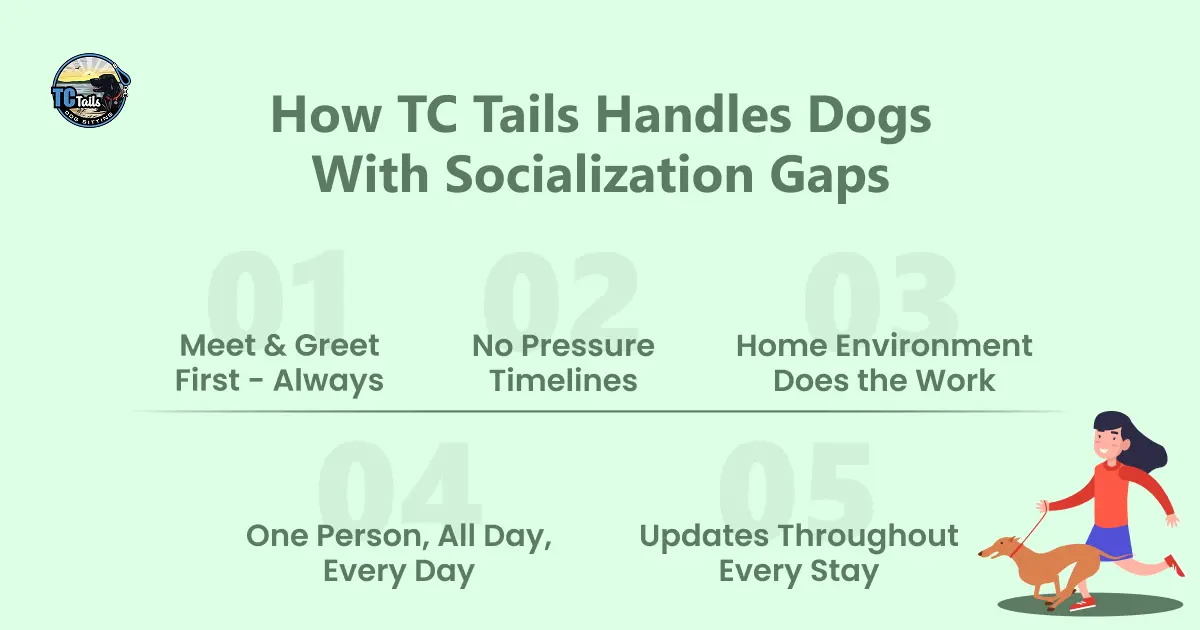
We’re going to be straight with you: TC Tails is not a socialization training program. Jared isn’t a dog trainer, and he doesn’t position himself as one. But 20+ years of caring for dogs across every temperament – anxious rescues, reactive large breeds, elderly dogs with health needs, dogs that got turned away everywhere else – has built genuine experience with what undersocialized dogs actually need.
Here’s what the process looks like at TC Tails for a dog that’s nervous or has limited social experience.
The meet and greet comes first. Always. Every new dog gets a meet and greet before any stay. This isn’t a formality. It’s Jared’s chance to see how your dog actually behaves – in a real environment, with real stimuli – before committing to an overnight or multi-day stay. If your dog needs a slower introduction to Charlie, that happens here, too. Off-leash, in the yard, with Jared watching both dogs from close range.
No pressure timelines. Some dogs take 10 minutes to relax around Charlie. Some take most of the first day. Jared doesn’t rush it. The yard is big enough that both dogs can coexist without being forced into proximity until the nervous dog chooses to approach.
The home environment does a lot of the work. This sounds simple, but it matters. A home feels like home. It smells like a home, it sounds like a home, it has the same kind of furniture and rhythms a dog already knows. That baseline familiarity reduces the cognitive load on an anxious dog significantly. They don’t have to manage kennel sounds, concrete floors, and group chaos on top of meeting a new dog.
Jared is home all day, every day. No rotating staff. No shift changes. No “everyone goes home at 6 PM.” Your dog has one consistent person from drop-off to pick-up, which is one of the most stabilizing things you can give an anxious or undersocialized dog.
Updates throughout every stay. Photos, videos, quick texts. You know how your dog is doing in real time, which means you can relax instead of spiraling with worry.
Conclusion
Not every dog is ready for group daycare, and that’s not a failure on your part or your dog’s. It’s just information. Information that, if you have it before booking, can save your dog from an experience that sets them back rather than moves them forward.
The right starting point for an undersocialized or anxious dog isn’t a room full of strangers. It’s a home, a patient caregiver, one calm dog, and no pressure to be anywhere near ready before they actually are.
That’s what TC Tails offers. If you’re in Traverse City or the Grand Traverse area and you’re wondering whether your dog is a good fit for daycare, boarding text Jared at 231-499-4048 and ask. He’ll give you an honest answer.
No hard sell. No pressure. Just 20+ years of experience and a genuine interest in making sure your dog has a good experience, whatever that looks like for them.
Visit tctails.com or text 231-499-4048 to start the conversation.
Frequently Asked Questions
Can an unsocialized dog go to daycare?
Technically yes, but it’s usually not a good idea without preparation. An unsocialized dog in a group daycare setting is likely to experience fear, stress, and over-arousal rather than positive social learning. The better approach is to start with controlled one-on-one introductions in a calm, home-like environment before ever entering a group setting. In-home dog boarding with a single stable resident dog is often the right first step.
Will daycare help socialize my dog?
Not on its own, and not for undersocialized dogs. Daycare is an environment for dogs that are already comfortable with other dogs. For dogs that aren’t, large-group daycare can worsen anxiety and reactivity by creating repeated, unmanaged fear experiences. Real socialization requires gradual positive exposure at the dog’s pace – that’s the opposite of a group daycare drop-in.
How do I know if my dog is too anxious for group daycare?
Watch for these signs: leash reactivity toward other dogs, cowering or hiding when meeting new dogs, a history of snapping or growling in social situations, or a past bad experience at a boarding facility or daycare. If your dog shows any of these, group daycare probably isn’t the right starting point. Talk to your vet or an experienced dog care provider before booking.
What is the best boarding option for an unsocialized dog in Traverse City?
In-home dog boarding with a small group and an experienced, on-site caregiver is generally the best fit. At TC Tails in Traverse City, undersocialized and anxious dogs are introduced gradually to resident dog Charlie in a low-pressure home environment with full-time supervision. Text Jared at 231-499-4048 to discuss whether your dog’s temperament is a good fit.
Is dog daycare bad for anxious dogs?
Large-group daycare is often counterproductive for anxious dogs. It creates the exact conditions – high stimulation, no escape routes, unfamiliar dogs – that trigger fear responses. For most anxious dogs, a quieter, more controlled environment like in-home Dog boarding is significantly less stressful and more beneficial than group daycare.
What should I do if my dog had a bad experience at daycare?
Give them time and space to decompress first – at least a few days at home with no pressure. Then consult your vet or a certified dog trainer about what the experience revealed about your dog’s socialization needs. Don’t send them back to the same group setting immediately. Consider in-home dog sitting as a gentler next step, with introductions to other dogs only when your dog is calm and ready.
