
You walk through the door. You’ve been gone four days and you cannot wait to see your dog. They look up. Maybe they wag a little. Then they shuffle over to their bed, curl up, and that’s basically it for the next several hours.
No zoomies. No jumping. Just… quiet.
So you start second-guessing everything. Was the boarding place bad? Did something happen? Are they punishing you for leaving? You were excited to come home and instead you feel kind of terrible.
Here’s the thing – this reaction is incredibly common. It’s one of the first things people bring up after using a dog overnight boarding or any pet boarding Traverse City service for the first time. And the good news is that most of the time, what looks like sadness is actually something much more ordinary. Your dog isn’t grieving. They’re just unwinding.
But “most of the time” isn’t “all of the time.” So it’s worth knowing what normal actually looks like, what the real cause is, and exactly when you should stop waiting and call your vet.
Most dogs show withdrawn, low-energy, or clingy behavior for 24 to 72 hours after boarding. It’s a normal decompression response – not sadness, not punishment. Your dog’s stress hormones are resetting, their routine is re-establishing, and their nervous system is coming down from several days of heightened alertness. Give it two to three days before you worry.
What Is Post-Boarding Adjustment? Post-boarding adjustment is a temporary behavioral shift that happens after a dog returns home from a boarding facility for dogs. It shows up as low energy, reduced appetite, more sleep than usual, and mild withdrawal from normal activities. It reflects the body’s hormonal and neurological recalibration process after days of environmental change – not a sign of emotional damage or a bad boarding experience.
- Your dog seems sad after boarding because their stress hormones are dropping back to normal. It’s biology, not emotions.
- Most dogs are back to themselves within 24 to 72 hours. You don’t need to do anything except restore the routine.
- Watch for: no eating after 48 hours, vomiting, bloody diarrhea, coughing, or behavioral changes that weren’t there before the stay.
- In-home dog overnight boarding like TC Tails produces a milder, shorter adjustment because the stay itself is calmer.
- If it’s past 72 hours and something still feels off – call your vet.
Traverse City, MI At TC Tails, we provide in-home dog overnight boarding and pet boarding Traverse City families have relied on for over 20 years. Based at 310 S. Division St. in Traverse City, Michigan, we serve dog owners throughout the Traverse City area including Acme, Garfield Township, and surrounding northern Michigan communities. Every dog who comes through our door gets a free meet-and-greet, personalized care matched to their routine, and a stay in a real home – not a kennel. Operated by Jared, a pet first-aid and CPR certified caretaker who is home full time.
- Post-boarding quietness lasting 24 to 72 hours is completely normal and doesn’t need any intervention beyond patience
- The real cause is cortisol dropping back to normal after days of heightened alertness – your dog’s body is literally recovering
- Symptoms that stick around past 72 hours, especially vomiting, diarrhea, or no appetite at all, are worth a vet call
- In-home dog overnight boarding typically produces a shorter, milder adjustment because the whole experience is calmer to begin with
- Dogs who board with a consistent caretaker they know bounce back noticeably faster
What “Post-Boarding Sadness” Actually Looks Like
Before you can figure out what’s going on, it helps to get specific about which behaviors we’re actually talking about. “Sad” covers a lot of ground.
They sleep. A lot. This is the one owners notice first. Your dog moves in slow motion, keeps going back to their bed, and seems completely uninterested in the things that normally get them moving. For the first day home, this is the most common and most harmless version of post-boarding recovery. It looks dramatic. It isn’t.
They don’t eat much. Some dogs skip a meal – sometimes two – after coming home from a boarding stay. Even dogs who ate fine throughout their stay can be slow to eat at home. That sounds counterintuitive, but it makes sense: their hunger cues got recalibrated in an unfamiliar environment. Give them a day before you make it a concern.
They follow you everywhere. The flip side of withdrawal is velcro behavior. Some dogs come home and immediately glue themselves to you – under your feet, beside you on the couch, waiting outside the bathroom door. This is reassurance-seeking, plain and simple. It typically fades within a day or two as they confirm that you’re back and the routine is restored.
They’re just… quiet. The dog who normally barks at squirrels and plays with every toy in the basket just sits there looking at the wall. It reads as sulking. It looks pointed. It is not. They’re doing the neurological equivalent of a long exhale. Totally normal. Slightly unsettling to watch.
Read More About: Signs Your Dog Needs a Pet Sitter Instead of Boarding
Why Dogs Act Different After Dog Overnight Boarding
People often assume the behavioral shift means something went wrong during the stay. That’s a natural assumption but usually an inaccurate one. The reason dogs act differently when they come home from dog boarding Traverse City has nothing to do with whether they were well cared for – it’s just what happens to a dog’s body after any extended boarding stay, even a genuinely good one.
Let me explain what’s actually going on.
Cortisol builds up throughout the stay. A 2019 study published in Applied Animal Behaviour Science found that dogs in commercial kennels showed elevated cortisol levels the entire time they were there – even dogs who showed no visible signs of stress at all. Cortisol is your dog’s primary stress hormone. When they come home and that cortisol starts dropping back to normal, the drop itself produces low-energy, slow, flat behavior. It’s not sadness. It’s the biochemical version of crashing after an adrenaline spike.
The sensory environment at any boarding facility for dogs is intense. Even a well-run, genuinely caring facility is louder, more stimulating, and socially more demanding than your living room. Your dog has been processing that input continuously for days. Coming home to quiet is not emotionally cold – it’s neurologically necessary. Think about how you feel after a week of back-to-back social obligations. You’re fine, you’re not traumatized, but you need a day on the couch with nobody talking to you. Same principle.
Their routine got disrupted. Dogs don’t just like routine – they anchor their sense of safety to it. Feeding times, walk times, who’s around, what the smells are, when the lights go off. All of that shifted during the boarding stay. Coming home means re-learning the routine, and that takes a couple of days to click back into place.
Coming home from group settings is its own adjustment. After doggy day care Traverse City or group boarding, your dog has been managing social dynamics with multiple other dogs around the clock. Coming home to a quiet house with just you is a massive contrast. The behavioral shift isn’t telling you the experience was bad. It’s telling you the contrast is significant.
Thinking About Your Dog’s Next Stay? TC Tails offers in-home dog overnight boarding in Traverse City – a real home, not a kennel. No crates, no rotating staff, no barking echoing off concrete walls. Jared’s home full time and has 20-plus years of experience. |
How Long Does This Usually Last?
This is what most Traverse City dog owners actually want to know. The timeline is consistent enough that you can use it as a practical guide.
The first 24 hours is when it tends to look the worst. Low energy, slow eating, lots of sleeping. Your dog’s cortisol is at its highest when they first return, so the recovery is at its most visible. Don’t panic. Don’t start researching traumatized dogs at midnight. Just let them settle.
By 48 to 72 hours, most dogs are back. Appetite returns, energy returns, and you’re getting the normal reactions you expected at pickup. If your dog was physically healthy throughout the stay, this is the window where the reset completes.
Past 72 hours is where you pay attention. A dog still acting withdrawn on day four, or still not eating normally on day three, is no longer in the normal adjustment window. That’s worth a vet call – not because something is definitely wrong, but because you want to rule out illness or injury before assuming it’s behavioral.
The American Veterinary Medical Association’s companion animal care guidelines are clear that behavioral changes persisting past expected recovery windows after any care transition should be evaluated by a vet to rule out underlying physical causes. That’s just good standard practice.
Read More About: What Happens During a Dog’s First Day at Doggy Daycare?
Warning Signs You Shouldn’t Ignore
Here’s where it gets practical. Most dogs who come home from pet boarding Traverse City looking “sad” are fine. But some aren’t. Knowing the difference is genuinely useful.
Normal – just give it time:
- Sleeping more than usual for the first day or two
- Eating less at the first couple of meals back home
- Quieter than normal but still responding to their name and recognizing you
- Mild clinginess that eases up within 48 hours
- Slightly loose stools on the first day back (diet transition is common)
Worth monitoring a little more closely:
- Still not back to normal appetite by day two
- Still noticeably flat or disengaged by day three
- One or two episodes of vomiting with no blood present
- Reluctance to go to their usual spots around the house
Call your vet. Don’t wait:
- Complete appetite refusal for more than 48 hours after coming home
- Vomiting more than twice, or any blood in the vomit
- Bloody diarrhea, or diarrhea that’s still going on after 48 hours
- Any physical injury that wasn’t there before the stay
- Aggression that wasn’t there before boarding
- A dry, honking cough, nasal discharge, or labored breathing
That last group is important. Kennel cough is one of the most common illnesses that comes home from a boarding facility for dogs, even when every vaccination box has been checked. The Bordetella vaccine helps but doesn’t make your dog immune. Kennel cough symptoms typically show up two to five days after returning. If your dog develops that characteristic dry, repetitive cough within a week of coming home, call your vet the same day. It’s very treatable, but it spreads fast and it needs attention.
Concerned About What Your Dog Experiences During a Stay? TC Tails keeps the group small, the environment calm, and sends photos and updates throughout every visit. You’ll never wonder what’s going on. |
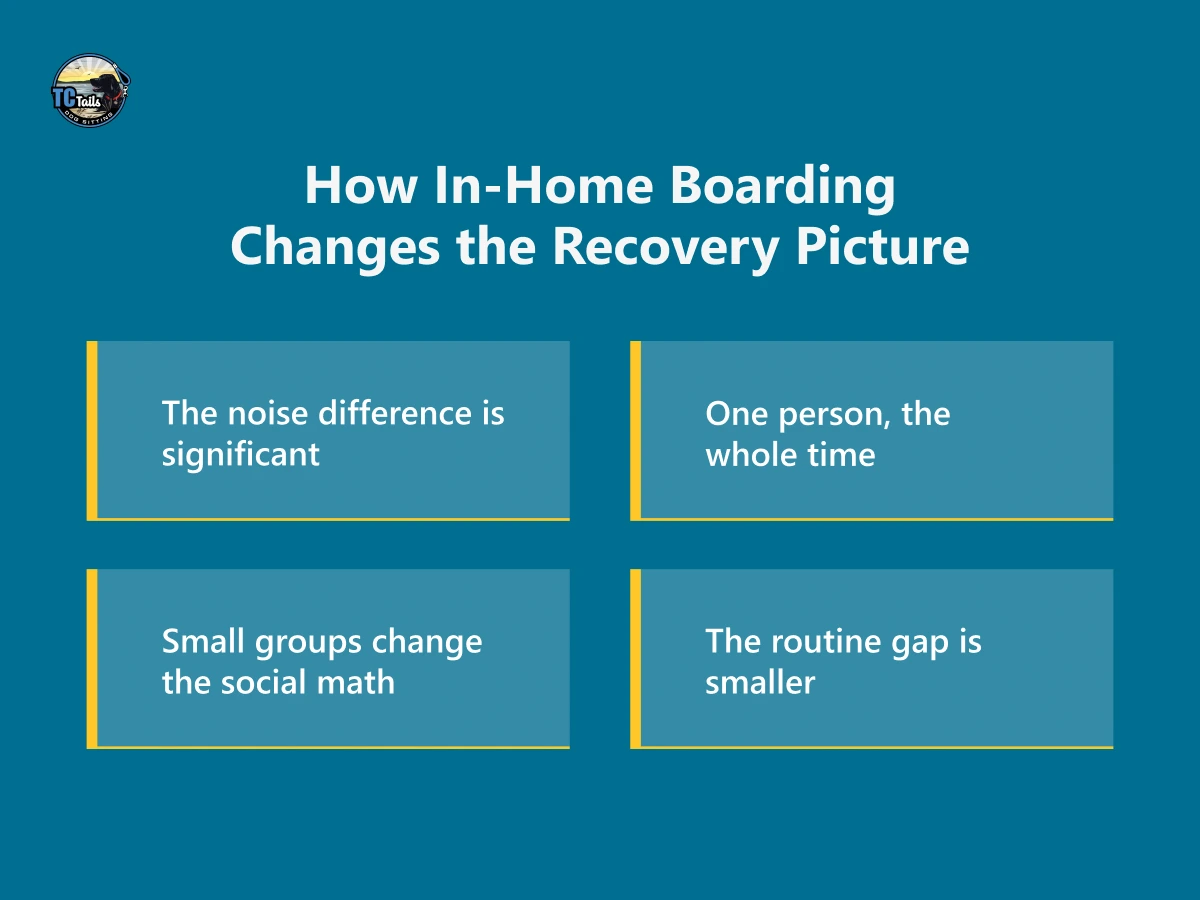
How In-Home Boarding Changes the Recovery Picture
This isn’t a pitch for one type of care over another. It’s a direct consequence of the physiology we just walked through.
If the post-boarding adjustment is driven by cortisol from noise, social overload, and routine disruption – then the intensity of that adjustment is directly related to how much of those three things your dog experienced during the stay. And that varies enormously between a commercial kennel and an in-home environment like TC Tails.
The noise difference is significant. Traditional kennels are loud. Dogs bark. Barking echoes in concrete-and-metal spaces. It doesn’t stop at night. A home with two or three dogs is fundamentally different. Quieter stays mean lower cortisol throughout, which means a smaller hormonal crash to recover from when they come home.
One person, the whole time. Dogs form attachments to specific people. At TC Tails, Jared is physically present all day and overnight – not a rotating roster of kennel staff on different shifts. That consistency removes one of the biggest anxiety drivers in a boarding stay. Your dog isn’t adjusting to a new person every eight hours.
Small groups change the social math. Managing relationships with six or eight unfamiliar dogs is genuinely taxing for most dogs. Managing one or two familiar dogs in a home setting is not the same experience. Less social complexity during the stay means less social decompression needed when they come home.
The routine gap is smaller. At TC Tails, feeding and exercise are adjusted to mirror what your dog does at home where possible. Coming back to your routine is less of a leap when the boarding routine wasn’t dramatically different to start with.
Owners who’ve made the switch from a traditional kennel to in-home dog and cat boarding at TC Tails consistently tell us the coming-home behavior changed. Dogs bounced back faster. The first day home looked more normal. That’s not a coincidence – it’s the predictable result of a lower-stress stay.
What Traverse City Dog Owners Ask Us Most
“Does the way my dog acted when I picked them up mean the boarding was bad?”
It doesn’t, usually. This one comes up all the time. Mild post-boarding adjustment happens even after great stays. Even dogs who were genuinely happy, well-fed, and well cared for show some version of the quiet homecoming. The quality of the experience shows up in physical health, no injuries, and how fast your dog returns to themselves – not in whether they had a calm first day back.
“Are they punishing me for leaving?”
No. And I want to say this clearly because it’s one of the most persistent myths in dog ownership. Your dog is not staging a protest. They’re not withholding affection to make a point. That’s a very human behavior that dogs genuinely don’t do. What looks like sulking is neurological recovery. Your dog loves you exactly as much as they did before you left. They’re just tired.
“If my dog had a hard time adjusting, should they ever board again?”
It depends on what drove the reaction. Mild adjustment with a quick recovery? No reason they can’t board again – especially if you choose a calmer, smaller in-home option. Prolonged adjustment, physical symptoms, or obvious anxiety that stuck around for days? Worth a real conversation with your vet and your boarding provider before the next trip. Not every environment is right for every dog, and figuring that out before you leave for another week is worth the time.
Want a Boarding Stay Your Dog Actually Recovers From Easily? TC Tails provides dog overnight boarding and pet boarding Traverse City in a real home – small group, full-time caretaker, no crates unless you ask for them. |
Conclusion
Your dog acting quiet, clingy, or low-energy after a boarding stay is almost always normal. It’s not grief. It’s not resentment. It’s their body resetting after days of being somewhere unfamiliar – cortisol dropping, routine re-establishing, nervous system coming back down.
For most dogs who’ve been through pet boarding Traverse City, that window is 24 to 72 hours. No intervention needed beyond getting back into your normal routine and giving them a little space.
What does matter is knowing when it stops being normal – and knowing that where your dog stays directly affects how hard that adjustment hits. The calmer the stay, the easier the homecoming.
If you want dog overnight boarding or doggy day care Traverse City that’s built around your dog’s comfort from the start, book a free meet-and-greet with TC Tails. We’ll figure out together whether it’s the right fit for your dog before you commit to anything.
FAQs
Is it normal for a dog to be sad after boarding?
Yes, it’s very common. Most dogs come home from dog overnight boarding and spend the first 24 to 72 hours sleeping more, eating less, and being quieter than usual. It’s not actually sadness – it’s a decompression response as their stress hormones drop back to normal and their routine resets. Think of it as a system reboot. Most dogs are back to themselves within two to three days. If the change is still going strong after 72 hours or you’re seeing physical symptoms, that’s when to call your vet.
How long does post-boarding depression last in dogs?
For most dogs, the flat, low-energy behavior after a boarding facility for dogs stay lasts 24 to 48 hours. Anxious dogs and first-time boarders sometimes take a full 72 hours to fully bounce back. Once you hit the three-day mark with no improvement – especially if appetite hasn’t returned or you’re seeing vomiting or diarrhea – that’s past normal adjustment territory and worth getting a vet’s opinion on.
Why is my dog clingy after dog boarding Traverse City?
It’s reassurance-seeking. Your dog just spent several days without you, surrounded by unfamiliar people and other dogs, in an unfamiliar place. When they come home, they want to confirm that you’re back and everything’s okay. Mild velcro behavior for a day or two is completely normal and honestly kind of sweet. If it’s still intense after three days or is paired with anxiety behaviors like destructive chewing, heavy panting, or refusing to be alone at all, it’s worth talking to a trainer or vet about separation anxiety specifically.
Can pet boarding Traverse City cause my dog to get sick?
It can. The most common culprit is kennel cough, a respiratory illness that spreads fast in any group environment. Symptoms show up two to five days after your dog comes home – you’ll hear a dry, repetitive honking cough, sometimes with nasal discharge. The Bordetella vaccine helps reduce severity but doesn’t fully prevent it. If your dog starts coughing within a week of returning from a pet boarding Traverse City stay, call your vet. It’s very treatable when caught early. Mild gastrointestinal upset from the stress of the stay is also common in the first day or two, usually resolving on its own.
Should I try doggy day care Traverse City instead of overnight boarding?
It depends on your dog’s personality and what you actually need. Daycare is daytime-only care – great for sociable, high-energy dogs who need stimulation while you work. Overnight boarding is for travel or extended absences. In-home boarding covers both and tends to produce calmer behavior throughout the stay and easier homecomings, because the environment is closer to what your dog already knows. TC Tails offers a free meet-and-greet so we can assess your dog’s personality and tell you honestly which setup fits them best before you commit.
Does dog and cat boarding work for both pets at once?
Yes, but it depends entirely on the individual animals involved. Some dogs are reliably relaxed around cats; others absolutely are not. At TC Tails, any arrangement involving dog and cat boarding for the same household starts with an honest assessment of both pets – we’re not going to put animals together and hope for the best. If you’ve got both dogs and cats at home, ask your boarding provider directly what their process is for managing mixed-species stays. Any good provider should have a clear answer
