
You drop your kids at your parents’ place. They run inside without looking back. You drive away feeling completely fine.
Then you board your dog.
And for the entire trip – every meal, every meeting, every moment you’re supposed to be relaxing – some part of your brain is back home wondering if they’re okay. If they’re scared. If they think you abandoned them.
It sounds a little irrational when you say it out loud. Your kids can talk, reason, ask for what they need, understand that you’re coming back. Your dog can’t do any of that. So why on earth does leaving the dog feel so much worse?
Here’s what’s actually going on – and what genuinely helps when you’re using dog sitting services Traverse City or any in-home dog boarding before your next trip.
Leaving your dog feels harder than leaving your kids because your dog can’t understand explanations, can’t ask for reassurance, and depends on you completely for their emotional security. That creates a specific, intense form of guilt that doesn’t have a rational off switch. The best thing you can do is choose dog sitting services that give you real proof your dog is okay – and then actually let yourself believe it.
What Is Pet Parent Guilt? Pet parent guilt is the anxiety and emotional distress owners experience when leaving their dog in someone else’s care. It’s driven by the dog’s inability to understand absence, the owner’s awareness of that helplessness, and the unconditional nature of the bond. Research in anthrozoology – the study of human-animal relationships – consistently shows dog owners report higher pre-departure anxiety about pets than about human family members in many situations.
- Leaving your dog feels harder than leaving your kids because dogs can’t understand “I’ll be back” – and you know that.
- The guilt is real, documented, and extremely common among dog owners. You’re not overreacting.
- Three things loop in most owners’ heads before leaving: “Will they think I abandoned them?” “Are they stressed?” “Is the person caring for them actually paying attention?”
- What helps isn’t reasoning with yourself – it’s choosing dog sitting services Traverse City where you get real updates, photos, and proof your dog is genuinely fine.
- In-home dog boarding with a consistent, trusted caretaker resolves most pre-departure anxiety because the environment mirrors home.
Traverse City, MI TC Tails provides in-home dog sitting services Traverse City families have trusted for over 20 years. Located at 310 S. Division St. in Traverse City, Michigan, we serve dog owners across the Traverse City area including Garfield Township, Acme, and surrounding northern Michigan communities. Every stay starts with a free meet-and-greet so your dog knows Jared before you leave. Regular photo and video updates are sent throughout every stay – because peace of mind isn’t a bonus feature, it’s the whole point.
Key Takeaways
- Dogs can’t understand explanations, reassurances, or calendars – and that’s exactly why leaving them triggers a different kind of guilt than leaving your kids
- The guilt isn’t irrational. It’s a reasonable emotional response to a real dynamic: your dog’s complete dependency on you for safety and security
- Pre-departure anxiety in pet owners is well-documented in anthrozoology research and is more intense in people with strong human-animal bonds
- Choosing in-home dog boarding over kennel care directly reduces guilt because the environment is calmer, more familiar, and more transparent
- Regular updates with photos and videos are not frivolous – they are the primary thing that allows owners to actually enjoy their trip
You’re Not Weird – This Is Actually a Documented Thing
Let’s get this out of the way first. You are not being irrational. You are not projecting. You are not one of those people who loves their dog “too much.”
The guilt that dog owners feel before and during a trip is real, common, and well-documented. Research published in the Journal of Veterinary Behavior found that pre-travel anxiety about leaving pets was reported significantly more frequently and intensely than pre-travel anxiety about leaving children with family members. The researchers noted that the disparity was largely driven by one factor: the perceived helplessness of the pet.
Your kids can tell grandma they’re hungry. They can ask where you are. They understand “Mom’s at work and she’ll be back on Friday.” Your dog doesn’t have any of those tools. And you know that. That knowledge is where the guilt lives.
So no. You’re not being dramatic. You’re responding to a real emotional asymmetry in a relationship you genuinely care about. The problem isn’t the guilt – it’s that most of the usual ways we manage guilt don’t work especially well when the other party literally cannot be reasoned with or reassured.
Read More About: Signs Your Dog Needs a Pet Sitter Instead of Boarding
Why Dogs Trigger Guilt in Ways Kids Simply Don’t
There are a few specific things about the dog-owner relationship that create this particular flavor of guilt. Understanding them doesn’t make the guilt disappear, but it does make it easier to work with.
Dogs operate entirely in the present. They don’t have a concept of “Tuesday” or “five days.” When you leave, you’re just gone. There’s no mental framework for “she’ll be back.” Kids develop that understanding somewhere around age two or three. Your dog never will. Every departure looks permanent from their side – until you walk back through the door. That’s not a comfortable thing to sit with when you’re four states away at a conference.
The dependency is total and it’s your design. You chose to bring your dog into your home. You built their routine around yours. You’re the source of their food, their walks, their comfort, and their sense of safety. Kids grow toward independence – that’s the whole arc of parenting. Dog ownership doesn’t have that arc. Your dog is going to need you the same way at ten years old that they did at one. There’s love in that, but there’s also weight. When you leave, you’re stepping away from a relationship built entirely around your presence.
They can’t tell you what they need. Your kid, at basically any age, can communicate distress. They cry, they use words, they can be evaluated by another adult who reports back. Your dog can’t say “I’m anxious” or “I didn’t sleep well” or “I don’t like this person.” The information gap is real, and it’s one of the main reasons choosing the right pet sitting services matters so much – a good caretaker bridges that gap with photos, videos, and genuine observation.
The love is uncomplicated. Here’s a truth that parents say quietly if at all: your kids are complicated. You love them fiercely and they also frustrate you, push back, have opinions, and require negotiation. Your dog just loves you. Unconditionally, consistently, without agenda. Leaving that behind for a week hits differently than leaving a relationship that involves the full complexity of human family dynamics.
The Specific Thoughts That Loop in Your Head Before a Trip
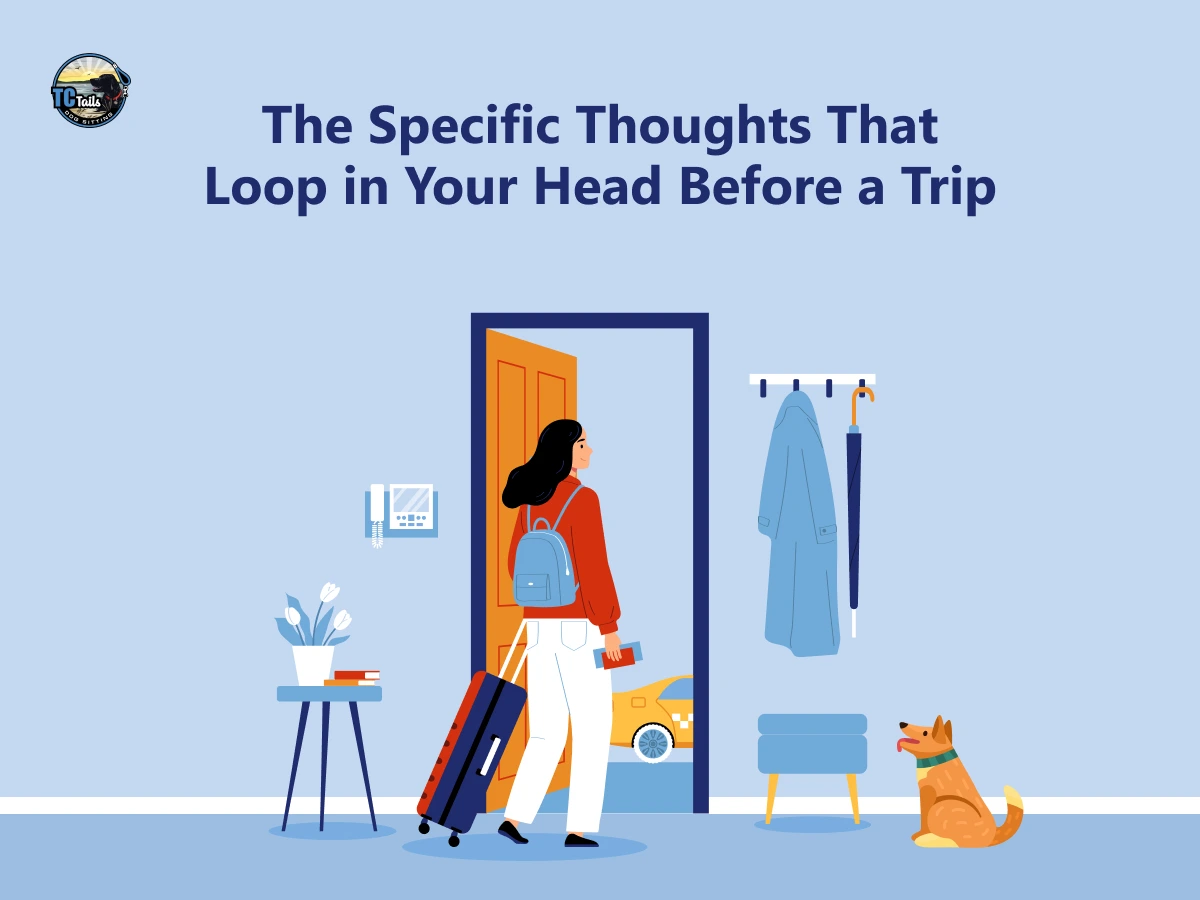
If you’ve experienced pre-departure guilt about leaving your dog, it probably sounded like some version of these. And if you haven’t left yet but you’re planning to use dog boarding Traverse City services for the first time, this is likely coming.
“Will they think I abandoned them?” This one doesn’t go away with logic. You know intellectually that your dog won’t permanently conclude you’ve left forever. But you also know they can’t access that logic during the first few hours at a new place, when the familiar smell and routine are gone and you’re not there. It doesn’t help to tell yourself your dog “understands.” They don’t, not fully. What helps is knowing they’re with someone calm and experienced who knows how to settle an anxious dog.
“What if they’re scared and I’m not there?” This is related but different. It’s not about abandonment – it’s about protection. You are your dog’s safe person. When something startles them, when they’re in an unfamiliar environment, when another dog is too rough during play – you’re normally there. During a boarding stay, you’re not. Choosing in-home dog boarding with a genuinely attentive caretaker is the closest thing to a real answer to this one.
“Is the person actually watching them?” This might be the most practically grounded version of the guilt. Commercial kennels can have 30, 40, 50 dogs. You have no idea what the ratio of supervision is. You have no idea if anyone is actually paying attention when your dog is in a corner looking scared. This isn’t paranoia – it’s a reasonable question about a situation with real variability. It’s also the reason that dog sitting services Traverse City with small group sizes and regular photo updates are worth significantly more to owners than facilities that simply list their credentials.
Leaving Soon and Already Dreading It? TC Tails offers in-home dog boarding and dog sitting services Traverse City in a real home with Jared present all day and overnight. Small group, consistent routine, regular photo updates. Your dog will be genuinely fine – and we’ll show you. |
What Actually Helps (and What Really Doesn’t)
People offer a lot of advice to anxious dog owners. Some of it works. A lot of it doesn’t.
What doesn’t help:
Telling yourself “they’re just a dog” doesn’t help. It’s dismissive of a bond you’ve built over years, and it doesn’t change the emotional reality you’re operating in. If it helped, you wouldn’t be feeling guilty in the first place.
Checking in constantly during your trip doesn’t help. It keeps the anxiety active. Every time you reach for your phone to ask for an update, you’re signaling to yourself that something might be wrong. You’re maintaining the worry loop rather than closing it.
Choosing a care option purely based on price doesn’t help. Guilt after a trip, when your dog comes home looking stressed or sick or clearly worse than when you dropped them off, is dramatically more distressing than the money you saved.
What actually helps:
Do a meet-and-greet before the trip. Let your dog spend time with the caretaker before the day you actually leave. If they’re comfortable and happy during that visit, you have real evidence – not reassurance, not hope, actual evidence – that the placement is right. At TC Tails, we do this for every single booking because we know the difference it makes for you and for the dog.
Choose overnight dog care that sends you unsolicited updates. Not updates when you ask. Updates that arrive without prompting, showing your dog playing, eating, and settled. When you have a photo of your dog curled up happily on a couch at 9pm, the guilt loop has something real to interrupt it with.
Build your dog’s routine into the care arrangement. The closer the boarding routine mirrors what your dog does at home, the less disruption they experience. Less disruption means less anxiety for them, which means less guilt for you, which means you can actually be present on your trip instead of half-present and half-worried.
Read More About: What Happens During a Dog’s First Day at Doggy Daycare?
How the Right Dog Sitting Services Change the Guilt Equation
Here’s the practical truth: most of the guilt dog owners feel before a trip is not about the trip. It’s about uncertainty. You don’t know what’s happening. You don’t know if your dog is okay. You don’t have visibility, and the absence of information lets your brain fill in the gaps with worst-case scenarios.
Good dog sitting services don’t just keep your dog physically safe. They close the information gap.
When Traverse City dog owners bring their dogs to TC Tails, a few things happen that directly address the guilt cycle. The meet-and-greet before the stay means your dog already knows Jared when you drop them off. There’s no first-day panic, no complete stranger, no overwhelming new environment. Your dog walks in and sees someone they’ve met. That matters.
During the stay, Jared sends photos and videos – not because you asked, but as a standard part of how things work. When you see your dog playing in a large fenced yard in the middle of the day, or settled on a dog bed at night in a quiet house, you have something real to replace the anxiety with. Not a promise. Not a credential. Actual visual evidence that your dog is fine.
The small group size means your dog is actually seen as an individual. They’re not one of thirty dogs in a kennel run. They’re one of a handful of dogs in a home, with a caretaker who notices when they’re a little off, who adjusts meals if needed, who handles medications without drama because 20-plus years of experience means nothing is a new situation.
That’s the version of pet sitting services that changes the guilt equation. Not perfectly – you’ll still miss your dog, because that’s what it means to love them. But you’ll leave knowing they’re genuinely okay, and that’s the difference between a trip you enjoy and a trip you survive.
Ready to Leave Without the Guilt Trip? TC Tails provides dog sitting services Traverse City and in-home dog boarding that keep you in the loop the whole time. Jared’s home all day, the group is small, and the updates are real. |
What Traverse City Dog Owners Tell Us Before They Leave
We hear the same things from dog owners in Traverse City before almost every trip. They’re not complaints – they’re just honest reflections of what this actually feels like.
“I’ve left my kids with my in-laws a hundred times and never lost sleep. Why is this different?”
Because your dog can’t call you. Your kids can. That’s most of it right there. The inability to get a direct check-in from the party you’re worried about keeps the worry alive in a way it doesn’t with people who can communicate. It’s not that you love your dog more. It’s that you have fewer feedback loops available to reassure yourself they’re okay.
“What if they don’t eat while I’m gone?”
Some dogs do go off their food for the first day at a new place. It’s common and usually self-correcting within 24 to 48 hours. At TC Tails, if a dog skips a meal, Jared notices and adjusts – maybe a different feeding time, a little something mixed in, a quieter spot away from other dogs. It doesn’t spiral into a crisis because someone’s actually paying attention.
“I feel terrible leaving them. Is that normal?”
Yes. Completely. The American Veterinary Medical Association recognizes the human-animal bond as a significant factor in owner wellbeing and in decisions about pet care. You’re not being excessive. You’re being someone who takes that bond seriously – and finding the right dog sitter Traverse City is how you honor it without letting the guilt ruin your trip.
Conclusion
Leaving your dog feels harder than leaving your kids because the relationship is built differently. They can’t reason, they can’t ask, they can’t understand a calendar. They depend on you completely – and you know that. So when you leave, you carry the weight of that dependency with you.
That guilt doesn’t make you irrational. It makes you someone who takes their dog’s wellbeing seriously. And the best thing you can do with it isn’t to argue yourself out of it. It’s to choose dog sitting services Traverse City that give you actual evidence your dog is okay – a real home environment, a consistent trusted caretaker, and photos that show up on your phone without you having to ask.
When you have that, the guilt gets a lot quieter. Not gone. But manageable. And your trip becomes something you can actually enjoy.
If you’re looking for in-home dog boarding or overnight dog care in Traverse City that handles your dog like family, book a free meet-and-greet with TC Tails before your next trip. Let your dog meet Jared first. Then leave knowing they’re genuinely fine.
FAQs
Why do I feel more guilty leaving my dog than my kids?
Because your dog can’t understand that you’re coming back. Your kids – even young ones – develop the cognitive ability to hold the concept of “later” and “return.” Your dog lives in the present. When you leave, you’re simply gone from their world until you reappear. That helplessness on their part creates a specific, hard-to-resolve guilt on yours that logic doesn’t really fix. It’s not that you love your dog more than your kids. It’s that the emotional math is genuinely different.
Is pet parent guilt normal?
Very. Research in anthrozoology – the study of human-animal relationships – consistently shows that dog owners report significant pre-departure anxiety when leaving their pets in care. People with strong human-animal bonds report this more intensely, which means that feeling it strongly is actually a reflection of the quality of your relationship with your dog. It’s not a sign of something wrong. It’s a sign the bond is real.
What helps with guilt about leaving your dog at a boarding facility for dogs?
The thing that helps most is real-time evidence that your dog is okay. Not promises – actual photos and videos of your dog settled and comfortable during the stay. A meet-and-greet before the stay so your dog already knows the caretaker when you drop them off also dramatically reduces first-day anxiety for both the dog and the owner. Choosing in-home dog boarding with small group sizes and consistent supervision gives you a much more reliable picture than a large commercial kennel.
How do I know if my dog sitter Traverse City is actually paying attention?
Ask direct questions before you commit. How many dogs are in the group at one time? Is the caretaker home during the day and overnight? How do they handle a dog who’s not eating? What do they do if a dog shows signs of stress? Good answers are specific, not vague. And then watch what happens during the stay – unsolicited updates with photos are the clearest signal that someone is genuinely present and paying attention, not waiting for you to ask.
Does in-home dog boarding actually reduce owner anxiety compared to kennels?
Yes, consistently. In-home dog boarding Traverse City environments reduce the three primary drivers of owner anxiety: uncertainty about supervision (one dedicated caretaker vs. rotating kennel staff), concern about environmental stress (home vs. high-noise kennel), and the information gap (regular personal updates vs. generic check-ins). Owners who switch from commercial kennels to in-home care almost universally report feeling more comfortable leaving and more present during their trips.
What should I tell my dog before I leave?
Honestly? Keep it short and calm. Long, emotional goodbyes increase your dog’s anxiety rather than reducing it because they’re reading your energy, not your words. A calm, matter-of-fact departure – a quick scratch behind the ears, a normal “bye” – signals that this is routine and okay. The guilt makes you want to explain, apologize, and linger. Your dog does better when you don’t. And if they’re staying with a dog sitter Traverse City they’ve already met and feel comfortable with, the transition is even smoother.
